
PA12 and PA11 are SLS nylon material families, not guaranteed performance levels. Use PA12 as a general-purpose shortlist and review PA11 when ductility, impact behavior, or repeated flexing may matter. Final selection should compare the exact powder grades, current technical data, print orientation, conditioning, geometry, environment, finish, inspection, and printed-part validation.
Content reviewed: 24 August 2026. This guide intentionally avoids transferring numerical properties between unspecified grades, processes, orientations, conditioning states, or test methods.
What do PA12 and PA11 mean in SLS?
PA12 and PA11 identify polyamide families used in powder-bed fusion. A family name helps form a material shortlist, but it does not identify one tensile value, elongation value, heat limit, chemical-resistance result, moisture response, surface result, or approved application.
For any consequential requirement, request the exact powder name and current technical data sheet. Confirm whether the data describes raw material, molded specimens, or printed specimens, and record the test method, orientation, conditioning, and specimen geometry.
PA12 vs PA11: what is the practical difference?
| Decision factor | PA12 shortlist | PA11 shortlist |
|---|---|---|
| Starting role | General-purpose nylon option | Ductility-focused nylon option |
| Review when | Balanced fit, function, finish, and environment are required | Impact, deflection, snap action, or repeated flexing may be important |
| Evidence to compare | Exact grade TDS and relevant printed-part tests | Exact grade TDS and relevant printed-part tests |
| Process variables | Orientation, cooling, conditioning, moisture, finish | Orientation, cooling, conditioning, moisture, finish |
| Validation focus | Critical dimensions, load, environment, assembly, inspection | Deflection, impact, fatigue, load direction, environment, inspection |
| Main limitation | Family-level claims do not prove part performance | “Flexible” does not mean elastomeric or suitable for every repeated-flex design |
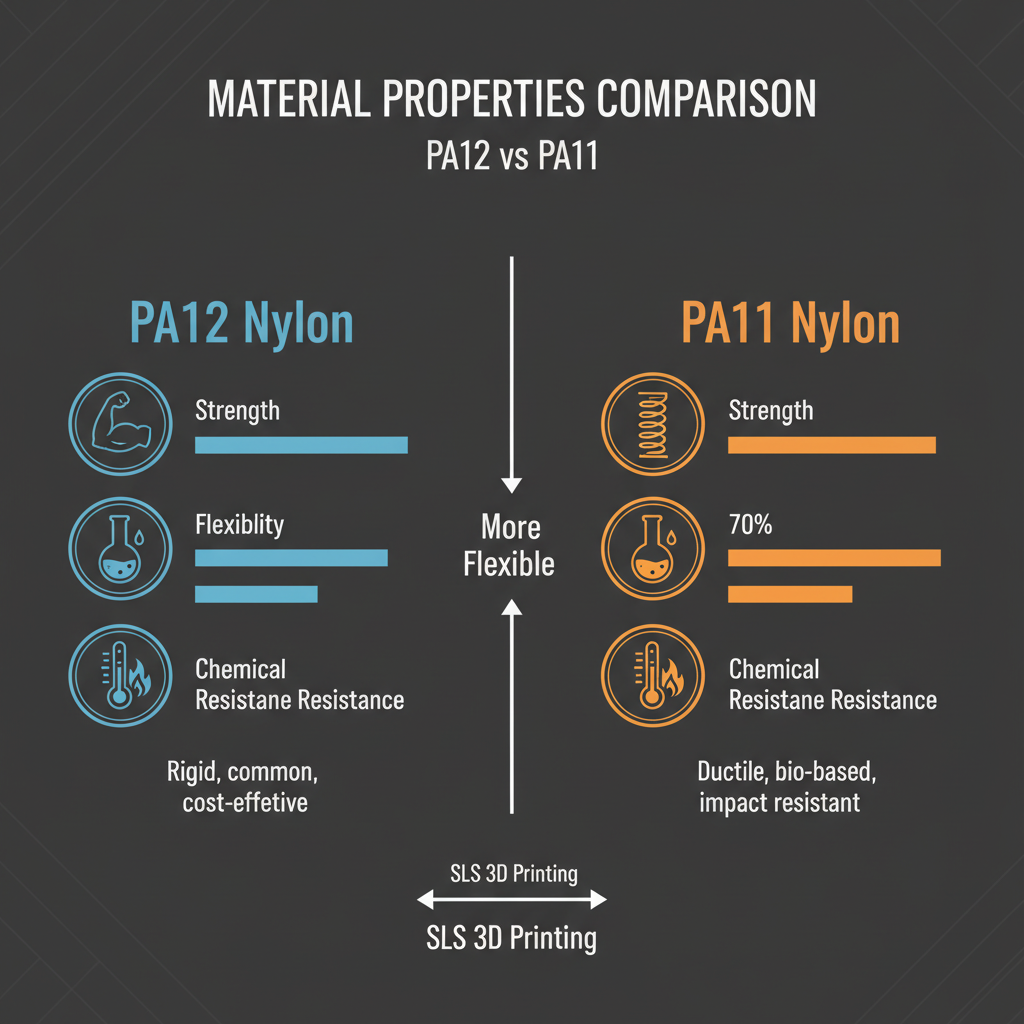
This is a qualitative comparison. It does not establish that one unspecified PA11 grade is stronger, more flexible, more sustainable, or more chemically resistant than every PA12 grade.
When should PA12 be shortlisted?
PA12 is a practical starting point for housings, brackets, ducts, covers, prototypes, and other functional parts when the project needs a broadly applicable nylon candidate. Review the exact grade against:
- load direction, fastening, creep, and failure criteria;
- critical dimensions, interfaces, and inspection method;
- moisture, chemicals, temperature, UV exposure, and service life;
- orientation, conditioning, color, and finishing;
- documentation or printed-part tests required for acceptance.
Do not treat “general-purpose” as proof of pressure sealing, fuel resistance, outdoor life, regulated use, or a universal tolerance.
When should PA11 be shortlisted?
PA11 is often reviewed when a design may benefit from more ductility, impact tolerance, or repeated flexing than the selected PA12 grade provides. Candidate applications can include snap-feature concepts, protective components, flexible-feature concepts, and impact-reviewed parts.
These are engineering-review starting points, not automatic approvals. Thin flexures, living hinges, clips, wearable parts, orthotic components, and vehicle parts require geometry-specific loads, cycle targets, environment, conditioning, finish, and validation criteria.
What claims require exact-grade evidence?
The following claims should not be copied from another supplier, grade, or test condition:
- tensile, flexural, impact, elongation, hardness, or fatigue values;
- heat limits, chemical compatibility, moisture behavior, or UV durability;
- renewable content, carbon footprint, recycled content, or sustainability labels;
- biocompatibility, skin contact, sterilization, food contact, or regulatory approval;
- printed-part tolerance, surface result, color consistency, or service life;
- price, minimum order quantity, stock status, production capacity, or lead time.
A current TDS can support a shortlist, but it does not automatically guarantee the production part. Use representative printed-part testing when failure, compliance, or durability is consequential.
How should engineers choose between PA12 and PA11?
- Define the function. Record loads, deformation, interfaces, critical dimensions, environment, finish, and service-life target.
- Name the evidence. Specify which requirements need a current TDS, certificate, inspection record, or printed-part test.
- Compare exact grades. Use equivalent test methods and conditioning where possible; do not compare unrelated headline values.
- Review manufacturing variables. Include orientation, geometry, cooling, conditioning, post-processing, and inspection.
- Validate the risk. Test representative printed parts when the application is safety-related, regulated, cyclic, chemically exposed, or difficult to inspect.
What should be included in a PA12 vs PA11 RFQ?
Send:
- CAD files and drawings;
- quantity or quantity breaks;
- load, deflection, impact, or cycle requirements;
- temperature, chemicals, moisture, and UV exposure;
- critical dimensions and inspection expectations;
- finish, color, assembly, and packaging needs;
- applicable standards and documentation;
- shipping destination and delivery target.
If a property is uncertain, describe the functional requirement instead of selecting a material from a family-level claim.
Related material and design resources
- Review the PA12 material selection page
- Review the PA11 material selection page
- Compare all SLS material families
- Read the SLS design guidelines
- Prepare an engineering-reviewed SLS quote
For a project-specific comparison, send the exact requirements and identify the evidence needed before production.
Frequently Asked Questions
Is PA11 always more flexible or impact-resistant than PA12?
No universal result should be assumed from the family name alone. PA11 is often shortlisted when ductility, impact behavior, or repeated flexing matters, but the decision should compare the exact current grades, specimen and print orientation, conditioning, geometry, load case, and relevant printed-part validation.
Is PA12 always the better choice for dimensional stability?
PA12 is often used as a general-purpose starting point, but dimensional suitability depends on the exact grade, geometry, orientation, cooling, conditioning, moisture exposure, finishing, and inspection method. Define the critical dimensions and environment, then confirm them on representative printed parts when the risk justifies testing.
Does the PA11 name prove bio-based content or a lower carbon footprint?
No. A material-family name does not prove renewable content, certified mass balance, recycled content, or a lower product carbon footprint. Request documentation for the exact powder grade and the specific environmental claim, including its scope, method, date, and applicable production site.
Can PA11 or PA12 be selected automatically for medical applications?
No. Medical or skin-contact suitability requires the exact grade, manufacturing controls, post-processing, cleaning, traceability, intended contact type and duration, applicable regulations, and project-specific evidence. A general PA11 or PA12 description is not a biocompatibility, sterilization, or regulatory approval.
What information is needed to compare PA12 and PA11 for an RFQ?
Provide CAD, quantity, load and deformation requirements, temperature, chemicals, moisture or UV exposure, critical dimensions, finish, color, inspection, service-life target, applicable standards, shipping destination, and delivery target. Identify which requirements need supplier documentation and which need testing on representative printed parts.
Related Case Studies
See how we have delivered results in similar projects
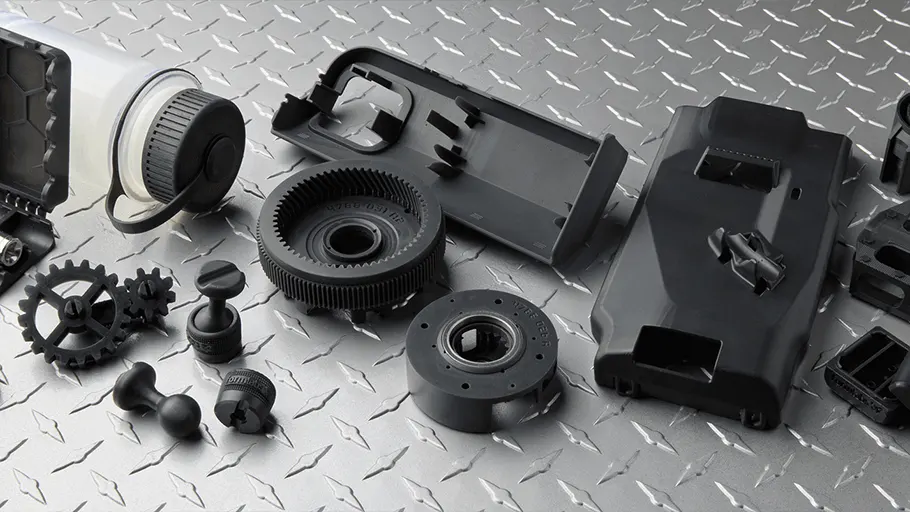 Medical
Spinal Orthosis Solution
Custom 3D printed spinal braces providing personalized solutions for scoliosis patients.
 Medical
Medical Prosthetic Components
High-performance prosthetic components with lightweight design and excellent mechanical properties.
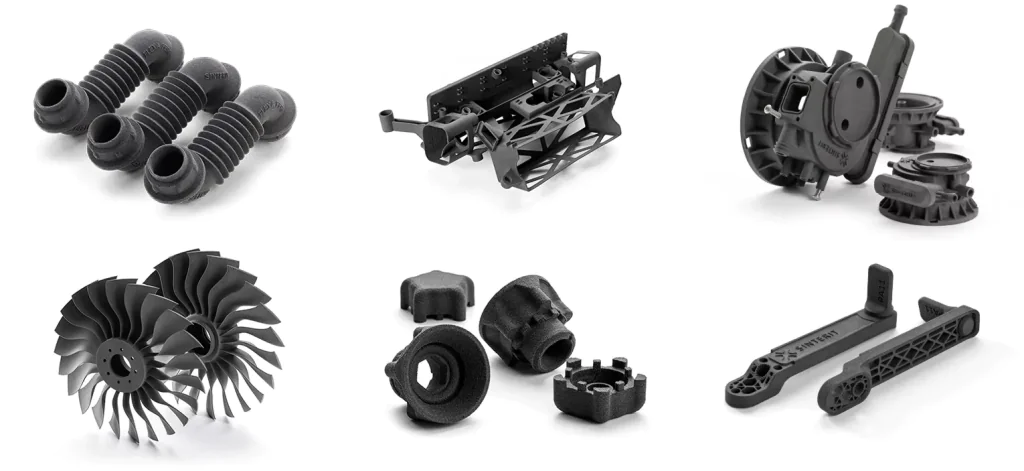 Industrial
Precision Small Parts Production
Batch production of precision small parts for multiple industry clients with complex geometries.