What does the new SLS PA12 study show?
A peer-reviewed study published on September 12, 2026 reports biological evaluation work on selective laser sintering (SLS) printed PA12 scaffolds. The results support further investigation of the tested PA12 specimens, but they do not establish that every PA12 grade—or TPM3D Precimid 1190Pro—has the same biological response. Medical and wearable decisions must remain tied to the exact material, build, surface condition and intended contact scenario.
Biocompatibility evaluation is a risk-based assessment of how a material or finished article interacts with a biological system under defined test conditions. It is not a property that can be transferred automatically between polymer families, grades, colors, finishes, manufacturing routes or final devices.
What did the researchers test?
Shubham Anand and Amit Kumar of the National Institute of Technology Patna studied SLS-printed PA12 scaffolds. According to the Springer Nature article abstract, the work included:
- scanning electron microscopy of microstructure and surface characteristics;
- 28-day immersion in phosphate-buffered saline (PBS);
- an antibacterial test against E. coli; and
- an MTT cytotoxicity study using the MCF-7 cell line.
The abstract reports approximately 0.17% weight loss after immersion and about 12% E. coli growth inhibition. It also uses the term “90% cell attraction” for the cytotoxicity result. Because that wording is not a standard acceptance statement and the full methods are subscription content, it should not be reinterpreted here as a general cell-viability value or a regulatory conclusion.
The authors describe the tested SLS PA12 as showing moderate stability and potential for short-term orthopedic implant research. This is the authors' study conclusion for their specimens—not a certification, a final-device approval or evidence for every SLS PA12 product.
How is the research different from Precimid 1190Pro evidence?
The two evidence sets answer related but different questions.
| Evidence set | Material and condition | Tests reported | What it can support | What it cannot prove |
|---|---|---|---|---|
| 2026 PA12 scaffold study | SLS-printed PA12 specimens described by the researchers | SEM, 28-day PBS immersion, E. coli test and MCF-7 MTT assay | Understanding the reported specimens and planning further PA12 research | Results for Precimid 1190Pro, every PA12 grade, every surface finish or a finished medical device |
| TPM3D biological evaluation reports | Precimid 1190Pro with chemical vapor smoothing, sample 25080574, batch 20250810 | ISO 10993-5 cytotoxicity, ISO 10993-23 skin irritation and ISO 10993-10 skin sensitization | Reviewing the tested material-and-finish configuration for relevant skin-contact projects | Untested colors, raw parts, paints, dyes, sterilization processes, other contact durations or final-device certification |
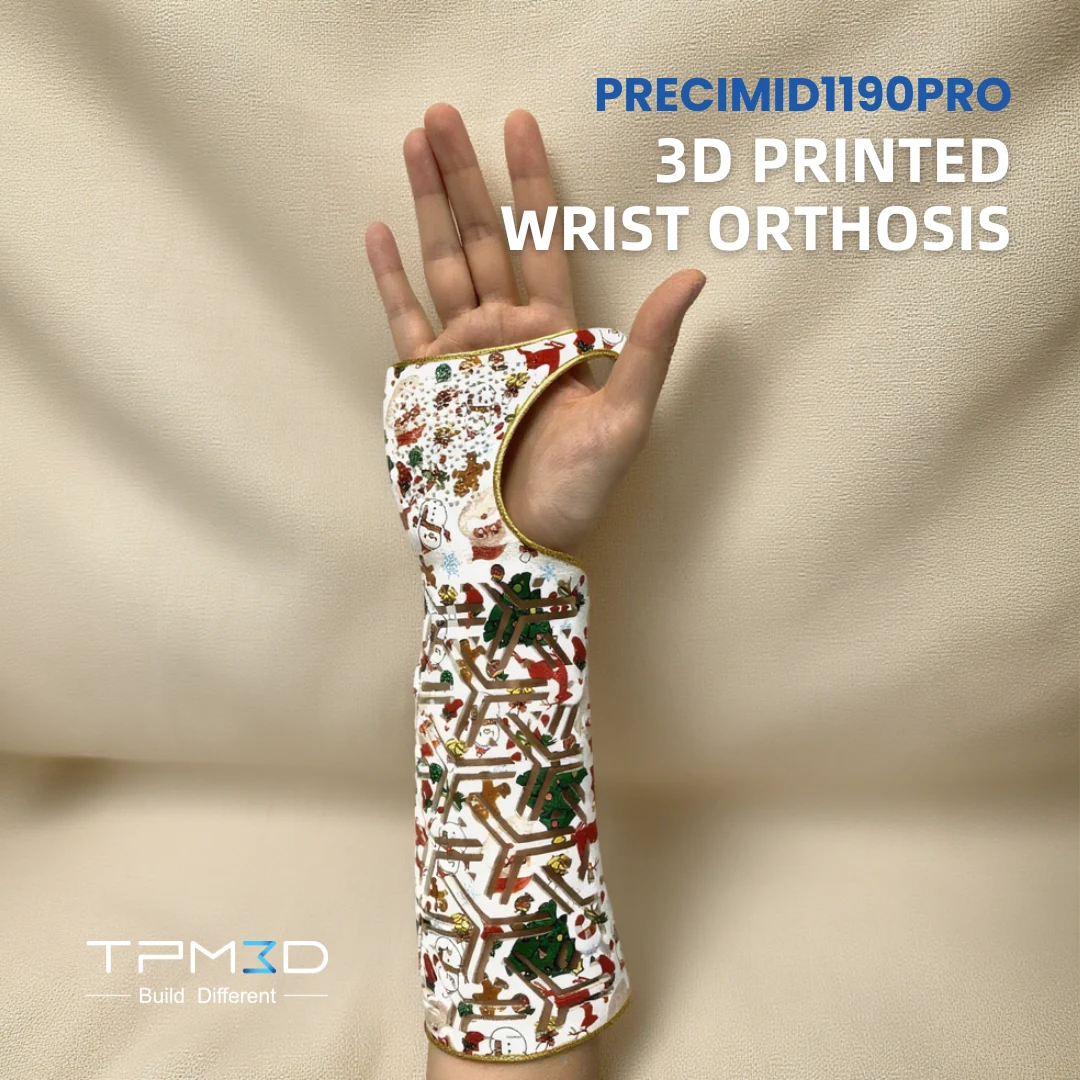
Precimid 1190Pro is a flexible co-polyamide SLS material used as a candidate for rehabilitation supports, orthotics, eyewear and wearable accessories. It is not the PA12 scaffold material evaluated in the Springer study. Engineers should treat the paper as external PA12 research and the TPM3D reports as first-party evidence for one defined Precimid 1190Pro configuration.
What do the Precimid 1190Pro reports say?
TPM3D's current report set applies to Precimid 1190Pro with chemical vapor smoothing, sample ID 25080574 and batch 20250810:
- Cytotoxicity — ISO 10993-5:2009: the 100% extract produced 72.6% L-929 cell viability; the laboratory concluded that the extract did not show potential cytotoxicity under the study conditions. Report 25080574-01-R02EN.
- Skin irritation — ISO 10993-23:2021: Primary Irritation Index (PII) 0, categorized as Negligible. Report 25080574-03-R02EN.
- Skin sensitization — ISO 10993-10:2021: 0% positive rate in the test groups, with no skin-sensitization reactivity observed under the study conditions. Report 25080574-05-R02EN.
These are report-specific results, not an unrestricted claim that every Precimid 1190Pro part is “biocompatible.” The Precimid 1190Pro material and report summary identifies the tested configuration and its limitations.
Why do material grade and surface finish matter?
Biological response can be affected by more than the polymer family name. Powder history, build parameters, orientation, porosity, cleaning, residual powder, vapor smoothing, dyeing, paint, sterilization and storage may change the finished article or its extractables. A result for a smoothed white specimen should not be assigned automatically to a raw, dyed or coated part.
The same boundary applies to design. A flexible wrist support and an implant scaffold differ in contact site, contact duration, mechanical loading, cleaning and clinical risk. The relevant biological evaluation plan should follow the final product's intended use, not an application photograph.
What should a buyer provide before material review?
For a medical, rehabilitation or skin-contact SLS project, provide:
- CAD geometry and the function of the finished component.
- Intended contact site, contact type and contact duration.
- Required color and whether the part is raw, smoothed, dyed, painted or coated.
- Cleaning, disinfection or sterilization requirements.
- Mechanical loads, flexibility targets and environmental exposure.
- Applicable regulatory pathway and the evidence requested by the responsible quality team.
- Whether testing is required on material coupons, representative parts or the final assembled device.
This information allows the medical and orthotics application team to compare the intended product with the tested configuration. For general production planning, see our SLS printing services, functional nylon qualification checklist and coupon-to-assembly testing plan.
Questions engineering teams should ask
Did the Springer study test Precimid 1190Pro?
No. The article reports results for the researchers' SLS-printed PA12 scaffolds. Precimid 1190Pro is a TPM3D co-polyamide material and has a separate report set. The two evidence sets should not be merged into a single material claim.
Do the TPM3D reports certify a finished medical device?
No. They document three biological evaluation tests for the identified material, batch and chemical-vapor-smoothed condition. Final-device evaluation remains dependent on intended use, processing, contact conditions, risk management and the applicable regulatory requirements.
Are painted or dyed Precimid 1190Pro parts covered?
Not automatically. Colorants, coatings and additional processing may change the surface or extractables. Equivalence should be documented or the final configuration should be assessed separately.
Can the reports be used for long-term skin contact?
The reports provide relevant test evidence, but they do not by themselves establish suitability for every contact duration. The intended contact type and duration must be reviewed against the complete biological evaluation plan.
What is the practical next step?
Share the CAD file, contact scenario, finish, cleaning or sterilization process and required standards. TPM3D can then compare those requirements with the tested Precimid 1190Pro configuration and identify where additional verification is needed.
TPM3D engineering perspective
The new PA12 paper adds useful evidence to the wider discussion around polymer SLS in biomedical research. Its most important lesson for procurement teams is not that “PA12 is biocompatible,” but that biological conclusions depend on defined specimens, methods and exposure conditions.
Precimid 1190Pro offers a separate, traceable evidence package for a chemical-vapor-smoothed configuration. That makes it a more informed starting point for selected rehabilitation, orthotic and wearable evaluations, while preserving the need for product-level risk assessment and validation.
If you are reviewing a skin-contact SLS component, use Discuss Your Application to send the CAD file and intended-use details for an evidence-bound material review.
Source and claim boundary
The news facts and study results above are attributed to Anand and Kumar's article in the Journal of Materials Engineering and Performance, published September 12, 2026. TPM3D did not conduct or independently reproduce that study. Precimid 1190Pro results come from the three named TPM3D laboratory reports and apply only to the tested articles and study conditions. No statement in this article constitutes final-device certification, regulatory approval or a universal material-performance guarantee.
Source & editorial note
- Original source
- Springer Nature — Journal of Materials Engineering and Performance
- Original publication
- September 12, 2026
- Editorial treatment
- Factual summary, independent engineering analysis and relevant TPM3D solution context; not a reproduction.